For most of my career, SEO has been about one dominant question:
“How do we rank higher on Google for the keywords that matter?”
That question hasn’t disappeared. But going into 2026 and beyond, it’s no longer enough.
We’re now in a world of:
- AI Overviews and “zero-click” answers
- Chat-based assistants that summarise the whole web in one reply
- Generative engines (GEO territory) that remix your content into their own answers
- Users discovering brands on YouTube, TikTok, Instagram, marketplaces and AI tools, not just Google
As an SEO consultant, website builder and site flipper, I’ve had to completely rethink what “organic growth” means for my own projects and for clients.
This article is my updated playbook: how I’m approaching SEO in the AI era, what’s changed, what hasn’t, and where I believe the real opportunities are now.
What’s Actually Changed with AI (And What Hasn’t)
Let’s start by being very clear.
What has changed:
Generic informational content is now a commodity. 800–1,200 word “what is X” blog posts with no unique angle are instantly replicable by AI and easily summarised by AI Overviews.
A lot of “quick answer” searches never reach your site. AI Overviews, featured snippets and direct answers mean users get what they need without clicking.
Search journeys are more fragmented. People might:
- See you on TikTok or YouTube
- Ask ChatGPT or another assistant about your brand
- Search your name or product in Google
- Read a review elsewhere
- Then finally land on your site
Ranking is no longer the only (or first) touchpoint. AI assistants often summarise your content without attribution or mention you alongside competitors.
What hasn’t changed:
- Businesses still need leads, sales and revenue, not rankings.
- Users still want trustworthy, clear and helpful information.
- Google still cares about relevance, authority, user satisfaction and technical health.
- Brand strength and topical authority still win in the long run.
So I’m not abandoning SEO. I’m reframing it.
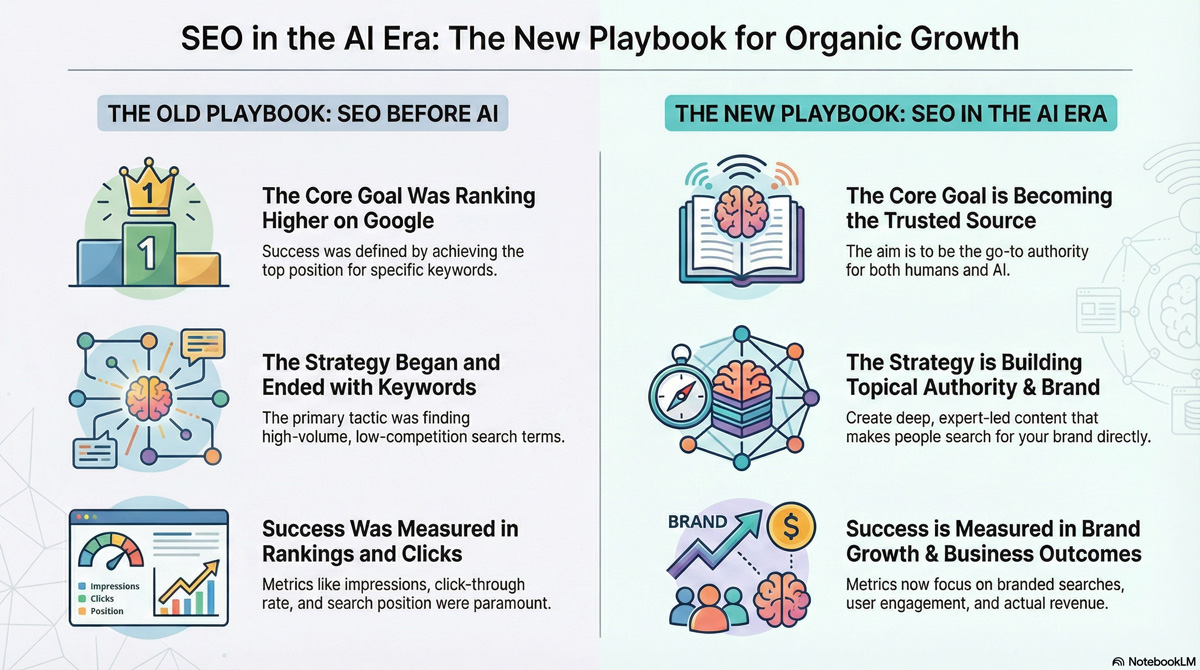
For me, SEO in the AI era is less about “ranking pages” and more about being the obvious, trusted entity whenever humans or AI systems look for answers in your space.
From Keywords to Entities and Topics
Classic SEO often started with: “Let’s find keywords with good volume and low competition.”
In the AI era, that thinking is incomplete.
The shift: from keywords → entities → topics
Instead of only asking “which keywords?”, I’m now obsessing over:
Which entities do we want to own?
- Brand names
- People
- Products
- Locations
- Problems and solutions
Which topics should we be unquestionably authoritative on?
Not just a single keyword, but a whole problem-space.
For example, instead of:
“We want to rank for ‘SEO consultant’.”
I think more like:
“We want to be recognised (by humans and machines) as a leading authority on SEO in the AI era.”
That means:
- Building topic clusters
- Covering all key subtopics and FAQs
- Structuring content so that LLMs can easily understand, chunk and reuse it
I’m designing content not just for humans and Google, but for AI assistants that will summarise and cite us.
Generative Engine Optimisation (GEO): Preparing Content for AI
If traditional SEO is about ranking in search engines, GEO (Generative Engine Optimisation) is about positioning your content so that generative models choose you as a source.
When I create or optimise content now, I ask:
“If an AI assistant is answering a question on this topic, are we:
- present,
- understandable,
- trustworthy enough to be used in the answer?”
How I “GEO-optimise” content in practice
When I’m writing or editing long-form articles, I:
- Use clear, descriptive headings (H2/H3) – So models can easily identify sections like “What is…”, “How to…”, “Pros and cons…”.
- Include definitions, bullet points and summaries – These structures are easy for AI to extract and reuse.
- Add FAQs – Short, direct Q&A segments map very well to conversational queries.
- Use consistent terminology and entities – Mention key brands, locations, product types and concepts clearly and consistently.
- Support with external authority where relevant – Linking to standards, laws, research or official docs reinforces trust.
- Structure internal links logically – So an AI crawling the site sees clear topical relationships.
- GEO is not about gaming AI models – It’s about making your content genuinely more structured, complete and machine-understandable, which also happens to be better for humans.
Organic Growth in the AI Era: My Core Pillars
To adapt, I’ve shifted from a pure “rank-and-bank” mindset to a more holistic organic growth system built on five pillars.
Pillar 1: Topical Authority, Not Random Articles
Instead of publishing disconnected posts, I build:
- Pillar pages – deep, evergreen guides that own a topic.
- Cluster pages – supporting articles that: Answer specific questions, Target sub-intents, Link back to the pillar
- Related assets – checklists, templates, tools, videos.
Topical authority is now essential because:
- AI models prefer strong, coherent sources on a topic.
- Google rewards sites that demonstrate E-E-A-T (Experience, Expertise, Authoritativeness, Trustworthiness).
- Users are more likely to stay within your ecosystem once they see you “get” their world.
Pillar 2: Depth, Originality and Experience
Mediocre content is dead. AI can generate it in seconds.
What still wins:
Real experience
- “Here is what I’ve seen across dozens of client accounts.”
- “This is how I built and sold a website in this niche.”
- “Here’s what actually moved the needle and what didn’t.”
Original data & experiments
- Before/after case studies
- Experiments with AI vs human content
- Tests on title formats, cluster depth, internal links, etc.
Opinion and frameworks
- How I approach audits in the AI era
- My framework for mixing SEO, content and paid in a full funnel
- My decision tree for when to use AI vs human writing
Search results are crowded with generic “10 tips” posts. What cuts through is: “This is how I actually do it.”
Pillar 3: Engagement and Task Completion
Traditional SEO looked heavily at:
- Rankings
- Impressions
- Clicks
In the AI era, I care more about what happens after the click.
Because if:
- Users stay, scroll, and explore more
- They complete tasks (calculator used, form filled, download, booking, call)
- They search for your brand name later
…you’re sending strong signals to both algorithms and assistants that you’re a trusted solution.
So I optimise for:
- Readability (short paragraphs, clear headings, summaries)
- On-page UX (fast, mobile-friendly, no annoying pop-ups)
- Next steps (contextual CTAs, related articles, tools)
- Clarity of value (“What do I do next?”, “How can George help me?”)
Pillar 4: Brand and Demand, Not Just Traffic
One of the most important mindset shifts I’ve made: I’d rather have 1,000 people who remember the brand than 10,000 anonymous visitors who bounce.
AI will continue to absorb more generic traffic. What AI can’t easily replace is a brand that people actively look for:
- Branded searches
- Direct visits
- Word of mouth
- Mentions in other people’s content
So I integrate SEO with:
- Thought leadership content (like this article)
- Email lists and owned audiences
- Social and video content that reinforce my positioning
- Speaking, podcasts, case studies that build real authority
SEO is now one channel in a bigger demand generation system, not an isolated tactic.
Pillar 5: AI as Leverage, Not a Replacement
I use AI heavily in my workflow, but I treat it as:
- A research assistant
- A first-draft generator
- A structure and idea machine
- A QA and editing helper
Not as:
- The final writer
- The strategist
- The voice of the brand
- The decision-maker
Where I still see humans as irreplaceable:
- Understanding business models and margin
- Setting positioning and messaging
- Deciding which battles to fight in a niche
- Bringing real-world context and nuance
The winning formula for me has been:
Human strategy + human judgment + AI-powered execution and iteration.
How I Now Approach an SEO Strategy in the AI Era
Here’s how this all comes together when I design an SEO strategy for a site – whether it’s my own or a client’s.
Step 1: Clarify the Real Outcome
Before touching keywords, I ask:
- What business outcome are we aiming for? Leads? Sales? Bookings? Email signups?
- Who is the ideal visitor?
- Where are they currently discovering solutions? (Google? YouTube? TikTok? Marketplaces? AI tools?)
This shapes everything else.
Step 2: Map the Topic and Entity Space
I identify:
- Core topics we must own
- Core entities (brand, service types, locations, problems)
- The questions and jobs-to-be-done behind each topic
From this, I design:
- Pillar pages
- Supporting articles
- Resource hubs and tools
Always thinking: “Would an AI assistant see this site as a comprehensive, structured authority on this subject?”
Step 3: Build AI-Ready Content
For each major topic, I:
Write deep, structured long-form content with:
- H2/H3 sections mapped to user intent
- Clear definitions
- Step-by-step frameworks
- Pros/cons, FAQs, examples
Ensure it’s:
- Expert-led (experience, opinion, case studies)
- Machine-readable (clean HTML, headings, schema where appropriate)
- Linkable (can easily be cited by others or referenced in assistants)
Step 4: Optimise for Engagement & Conversion
Once content is live, I look at:
- Time on page
- Scroll depth
- Internal link journeys
- Calls to action (CTAs) that match intent
I tweak:
- Layout and formatting
- Internal links and related content blocks
- CTAs, lead magnets, contact flows
Because in a world of AI Overviews and shrinking SERP space, every single click you do get is more valuable than ever.
Step 5: Integrate with Other Channels
I don’t treat SEO in isolation.
A strong article can also become:
- Video scripts (YouTube, Reels, TikTok)
- Carousel posts for social
- Email nurture sequences
- Lead magnets or mini-guides
- AI chatbot training data on the website
This is where AI tools help me repurpose efficiently, while I still control the message and quality.
What This Means for Businesses in 2026 (and Why It’s Not All Doom and Gloom)
There’s a lot of noise and fear at the moment:
- “AI will kill SEO.”
- “No one will click anything anymore.”
- “Content is pointless now.”
My view is more optimistic – but also more demanding.
The bad news
- Lazy, generic content will struggle even more.
- Websites built purely on thin affiliate content will have a hard time.
- Relying only on Google organic traffic is increasingly risky.
The good news
- If you’re willing to invest in real expertise, brand and helpful content, there is still huge opportunity.
- Many competitors will give up or do the bare minimum, leaving space for those who go deeper.
- AI can massively reduce the cost and friction of executing on a good strategy.
In other words: AI is reducing the value of average, while increasing the reward for excellent, well-structured, experience-led content.
FAQs: SEO in the AI Era
Is SEO still worth investing in with AI Overviews and chat-based search?
Yes – but how you invest must change. You’re no longer just chasing rankings; you’re building topical authority, brand and trust across multiple surfaces (Google, assistants, social, etc.).
Can AI-written content rank?
AI-assisted content can rank if:
- It’s expertly guided
- Fact-checked
- Enriched with real examples, case studies and opinions
- Properly structured and internally linked
- Purely auto-generated, unchecked content is risky – for quality, trust and long-term brand.
Should I still do keyword research?
Absolutely, but don’t stop at keywords.
Blend keyword data with:
- Topic mapping
- Entity analysis
- User interviews and real-world insight
Think: “Which problems and topics should we own?”, not just “Which phrases have volume?”.
How do I measure SEO success in the AI era?
I look at:
- Qualified organic traffic
- Branded search growth
- Lead and revenue attribution
- Engagement metrics (time, depth, return visits)
- Coverage of key topics (content gap vs competitors)
Rankings still matter – but as one metric, not the only one.
Final Thoughts: Rethinking “Organic Growth” in 2026 and Beyond
For me, the AI era hasn’t killed SEO. It’s forced it to grow up.
We are moving from:
“How do I get more clicks from Google?”
to
“How do I become the trusted, go-to source in my space – for humans and AI – and turn that into real business outcomes?”
If you’re a business owner, marketer or creator, the question isn’t:
“Is SEO dead?”
It’s:
“Am I willing to move beyond shortcuts and invest in brand, topical authority and genuinely helpful content using AI as leverage, not a crutch?”
That’s the journey I’m on with my own projects and with my clients, and it’s the direction I believe smart organic growth is heading in 2026 and beyond.
- About the Author
- Latest Posts

George Papatheodorou is a UK-based SEO consultant with a background in Electrical Engineering & Computer Science and an MBA in Telecoms. Since 2012, he has specialised in Search Engine Optimisation (SEO), Google and Bing Ads, and Conversion Rate Optimisation (CRO), empowering businesses to elevate their online presence, attract targeted audiences, and secure top search engine rankings.