Table of Contents
ToggleThe way people search for information online is changing. With the rise of voice assistants, AI chatbots and Google's AI-powered results, two new acronyms have entered the SEO lexicon: Answer Engine Optimisation (AEO) and Generative Engine Optimisation (GEO).
These concepts represent the evolution of traditional SEO into an AI-driven era. This guide will demystify AEO and GEO, explain how they differ and relate, and show UK business owners what it means for their search strategy going forward.
We'll cover definitions, origins, key differences, Google's latest AI search updates (like SGE), practical steps to adapt your SEO, and how it all ties back to SEO fundamentals like E-E-A-T and structured data.
By the end of this article, you'll understand:
- How to future-proof your SEO for answer engines and AI summaries
- The difference between optimising for direct answers vs AI-generated content
- Practical steps UK businesses can take to remain visible in AI search
What Are AEO and GEO? Definitions & Origins
Before diving into comparisons, let's define each term and where they came from.
Answer Engine Optimisation (AEO)
Answer Engine Optimisation (AEO) is the practice of structuring and optimising your content so that search platforms can directly provide answers to user queries, rather than just showing a link to your site.
In other words, AEO focuses on making your content the exact answer that a search engine or AI assistant will show to users for a given question.
The AEO Goal: If someone asks a question relevant to your business, AEO helps ensure your content is the one that gets quoted as the answer.
This idea grew out of the popularity of featured snippets, voice search and Q&A style queries over the past decade. Instead of only worrying about blue links and keyword rankings, AEO is about ensuring your content is answer-ready – clearly formatted to answer specific questions in a concise, accurate way.
Origins: As Google and other search engines started displaying quick answers (e.g. the answer box at the top of Google results, or Alexa reading an answer aloud), SEOs began emphasising techniques to capture those positions.
Initially, AEO was closely associated with:
- Winning featured snippets
- Appearing in voice assistant responses
- Google's "People Also Ask" boxes
- Direct answer formats on search results
Over time, AEO has evolved to encompass optimisation for any AI-driven answer platform – from Google's quick answer features to AI chatbots like ChatGPT or Google's Bard.
Generative Engine Optimisation (GEO)
Generative Engine Optimisation (GEO) is a newer concept focused on making your content a preferred source for AI-generated responses.
In other words, GEO is about optimising content so that generative AI systems (like large language models and AI search tools) will draw on it, summarise it, or cite it when creating answers for users.
The GEO Goal: Provide depth and authority so that AI "trusts" your content as a reliable resource when assembling a comprehensive answer or overview.
Unlike AEO – which is about providing a single direct answer – GEO is about providing depth and authority so that AI algorithms see your content as authoritative and worth citing.
Origins: GEO has emerged in response to the rapid growth of generative AI in search. In 2023, tools like OpenAI's ChatGPT exploded in popularity, and Google introduced its Search Generative Experience (SGE) which uses AI to compile answers from multiple sources at the top of search results.
Businesses found that users were getting summaries or answers directly from AI, sometimes without clicking through to websites. GEO arose as a strategy to remain visible in this paradigm: instead of optimising just for rank, you optimise so that AI platforms include your content when generating answers.
In Short:
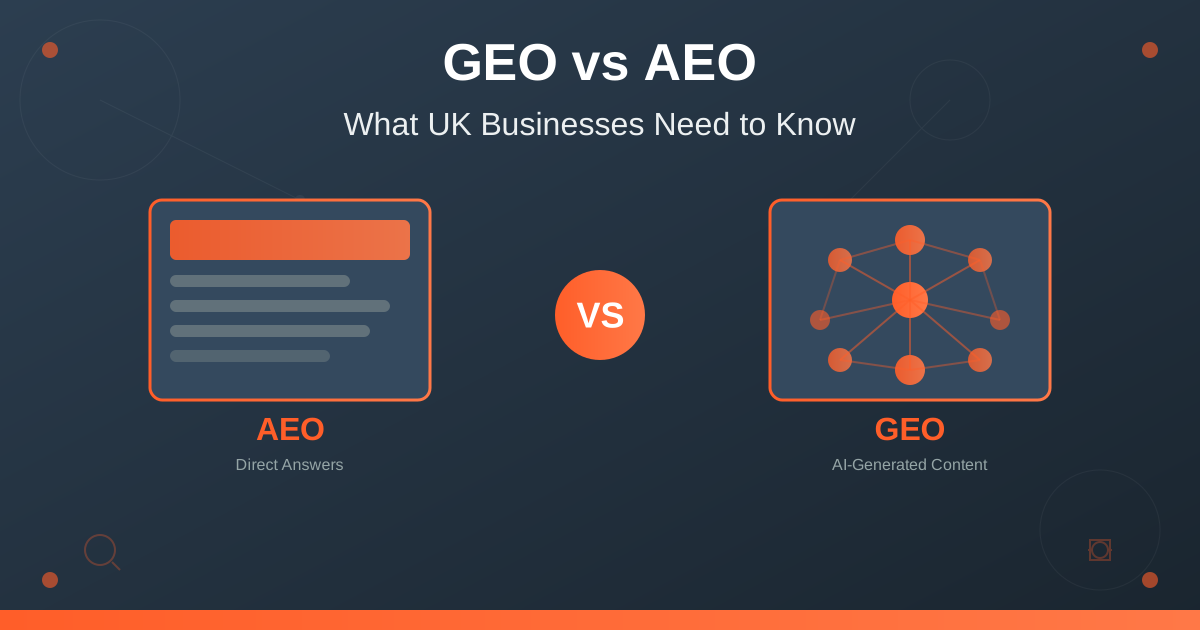
AEO makes you the answer.
GEO makes you the source.
AEO is about short, direct responses to specific questions, while GEO is about comprehensive, trustworthy content that AI will utilise and reference in longer answers or summaries.
AEO vs GEO: Key Differences in Strategy and Application
Though both AEO and GEO deal with optimising for new search formats, they serve different user intents and require different approaches. Here's how they compare:
Type of Query & Intent
AEO targets direct, question-driven searches – the who, what, when, how queries where the user wants a quick answer. Think of queries like:
- "What is VAT registration?"
- "How do I fix a leaky tap?"
- "When are UK tax deadlines?"
GEO, on the other hand, comes into play with broader or exploratory queries where users seek wide context or detailed insight. For example:
- "How does climate change affect UK businesses?"
- "Best practices for remote team management"
- "Comprehensive guide to workplace pensions"
Where Your Content Appears
With AEO, your content appears in:
- Featured snippets
- Answer boxes
- People Also Ask (PAA) dropdowns
- Voice assistant replies
- Other direct answer formats
With GEO, your content might appear as:
- Part of an AI-generated summary or overview
- Google's SGE panel at the top of results
- A cited source in conversational AI answers
- Referenced content in Bing's chatbot or other AI platforms
Key Distinction: AEO gets you the instant answer spot, while GEO gets you woven into the AI's answer narrative.
Content Style & Length
AEO-friendly content is typically short-form and highly structured:
- Clear sections and headings phrased as questions
- Bullet-point lists and step-by-step instructions
- Concise definitions (50-150 words)
- Easily scannable format
GEO-friendly content is usually longer-form and research-driven:
- Comprehensive blog articles and guides (1,500+ words)
- In-depth analysis with examples and statistics
- Original research and unique insights
- Demonstrates expertise and authority
Optimisation Focus
For AEO, the focus is on formatting and clarity:
- Using the answer-first approach (give a direct answer immediately)
- Adding FAQ sections
- Using schema markup like FAQPage
- Matching common question phrasings
For GEO, the focus shifts to trustworthiness, originality and authority:
- Ensuring content has evidence and references
- Written by or attributed to experts
- Updated regularly with fresh information
- Showcases unique insights and "information gain"
Success Metrics
AEO success can be measured by:
- Number of featured snippets captured
- Voice query responses where you appear
- Click-through rates from answer boxes
- Visibility in People Also Ask sections
GEO success includes metrics like:
- Brand mentions or citations in AI outputs
- Traffic coming from AI tools (e.g. Bing Chat)
- Overall share of voice in AI-generated answers
- Authority signals across the web
Important Note: AEO and GEO are not opposing strategies – they overlap and complement each other. A single piece of high-quality content can (and should) be optimised for both objectives: structured for answer snippets and rich enough for AI to draw on.
How Google's Evolution and AI Search Are Driving AEO & GEO
The search landscape has shifted dramatically in recent years, moving beyond the traditional "10 blue links" on a page. Understanding Google's evolution – and the rise of AI-powered search in general – is key to grasping why AEO and GEO matter.
From Search Engines to Answer Engines
Google has been transforming from a search engine into an answer engine for some time. Features like the Knowledge Graph (introduced 2012) and Featured Snippets (popularised mid-2010s) signalled Google's goal to answer questions directly on the results page.
Users in the UK and globally have grown accustomed to seeing definitions, calculators, weather, and quick answers without clicking any website. This trend set the stage for Answer Engine Optimisation.
For instance, if a user searches "What is council tax?", Google might show a snippet defining it and citing a source. If you're the local accountant who provided that well-structured answer on your blog, you've just captured that visibility thanks to AEO.
Voice Search & Virtual Assistants
The late 2010s saw a boom in voice-activated assistants:
- Amazon Alexa
- Google Assistant
- Apple Siri
Voice queries are often conversational and question-based ("Alexa, how do I unblock a sink?"), and the assistant typically reads out a single answer.
This further pushed the importance of AEO, because if your content was the chosen answer, you gained a big visibility advantage – even if the user never visits your site, they hear your brand.
Google's SGE and AI Overviews
Fast forward to 2023-2024, Google began testing and rolling out Search Generative Experience (SGE) – an AI-generated summary at the top of search results for certain queries.
SGE uses generative AI (built on large language models) to compile information from multiple sources and present an overview with citations.
Example: A user in 2024 might search "Best electric cars for city driving UK" and get a rich AI-generated paragraph comparing models, pulling facts from various sites, with clickable citations.
This is a prime example of where GEO comes into play: if your website had a detailed article on electric cars with plenty of facts and clear structure, the AI might include your insights in its summary.
Google's own representatives have stressed that standard SEO practices help here too – "Google says normal SEO works for ranking in AI Overviews", meaning there's overlap. Still, SGE represents a shift: ranking #1 isn't the only goal anymore; being one of the sources the AI trusts is equally important.
The Rise of Third-Party AI Search Tools
Beyond Google, users (especially younger demographics) are exploring alternative search methods:
- ChatGPT (180 million+ monthly users)
- Bing Chat/Copilot
- Perplexity AI
- AI features in Alexa or Siri
Many of these will give answers directly, often citing or at least drawing from web content.
A Gartner prediction suggests that by 2026, traditional search volume could drop by 25%, with over 50% of organic traffic potentially shifting to AI-driven search interfaces.
In the UK, where internet users are quick to adopt new tech, businesses can't ignore that a customer might ask ChatGPT for advice rather than Google.
Zero-Click Searches and New Metrics
With AI answers and rich results, we've entered the era of zero-click searches – where the user's query is answered without them clicking any website.
Over half of Google searches already result in no click, and AI answers will likely increase that. This is a double-edged sword for businesses:
- The downside: You might lose direct traffic
- The upside: You still gain exposure if your brand is featured in the answer
Example: If someone asks Google's AI "How do I improve my credit score?", it might display a summary: "…pay bills on time, check your credit report for errors, keep credit utilisation low…" and cite YourFinanceBlog.co.uk.
Even if the user doesn't click through, your brand has been positioned as an authority. This is why measuring success in the AI era includes tracking brand visibility and mentions, not just clicks.
Practical SEO Actions for Adapting to AEO and GEO
How can businesses in the UK actually implement AEO and GEO? Here are practical steps and best practices for each:
Optimising for AEO (Answer Engine Optimisation)
1. Identify the Questions Your Audience Is Asking
Start with keyword research focused on questions and long-tail queries. Use tools (or even Google's People Also Ask and Autocomplete suggestions) to find common questions in your niche.
For example, if you're a solicitor, queries like "What does a conveyancing solicitor do?" or "How long does probate take UK?" might be frequent. Build content around these questions.
2. Use Clear Q&A Formatting
Structure your content so that questions are explicitly asked and answered. This often means using headings (H2s or H3s) that are phrased as a question, followed by a succinct answer in the paragraph below.
For instance: "What are the tax deadlines for UK businesses?" as an H2, followed by a 2-3 sentence answer. This format directly signals search engines the content is answer-ready.
3. Answer First, Then Elaborate
Adopt the journalistic "inverted pyramid" style for answers. State the direct answer in the very first sentence of your response, then provide more detail or explanation in the following sentences.
Example: If someone asks "How often should I service my boiler?", your blog might answer:
"You should service your boiler annually to keep it running safely and efficiently." (That's the answer.)
"Most manufacturers and Gas Safe engineers in the UK recommend a yearly service, ideally before winter. Regular servicing helps prevent carbon monoxide leaks and maintain your warranty." (That's elaboration.)
4. Leverage Structured Data (Schema)
Implement FAQ schema or QAPage schema on relevant pages. This markup helps Google and Bing understand that your page has questions and answers, increasing the chances of getting rich results (like expandable FAQs in Google results).
Structured data acts like a "cheat sheet" for search engines and AI, explicitly highlighting the Q&A content.
5. Optimise for Featured Snippets
Consider the types of featured snippets (paragraph, list, table) and optimise accordingly:
- If the query is "steps" or "how to" oriented, present your answer as a short list
- If it's asking for a definition, provide a one-sentence definition followed by additional context
- Test your content by searching the question and seeing what Google currently shows
6. Voice Search Readiness
Remember that answers might be spoken aloud by voice assistants. Write in a natural, conversational tone that sounds good read out loud. Avoid overly complex sentences.
Also, ensure your content is easily accessible (mobile-friendly, fast-loading), since voice search often pulls from mobile results.
7. Keep Answers Up-to-Date and Accurate
If facts change or new information arises, update your answers. Answer engines value freshness and accuracy. For UK businesses, this could mean updating answers about regulations or tax rates annually.
8. Monitor and Refine
Track which queries you're getting featured for or driving voice traffic. Use Google Search Console to see queries that got impressions and whether your page was the one shown in a snippet.
Optimising for GEO (Generative Engine Optimisation)
1. Create Depth and "Data Density"
For GEO, long-form, comprehensive content is king. Ensure your key topics are covered in depth on your site (ultimate guides, research pieces, detailed how-tos).
Include unique insights, statistics, or case studies wherever possible. AI models prioritise content that offers something new or valuable rather than rehashing the same info.
Example: A local estate agent could publish an annual report on housing market trends in the UK with original data – AI loves citing unique stats like "average house prices in Essex rose by X% in 2025 according to [Your Company]".
2. Demonstrate E-E-A-T (Experience, Expertise, Authority, Trust)
Just as in traditional SEO, credibility matters. For GEO, make sure your content and website demonstrate expertise and trustworthiness:
- Include author bios on articles, highlighting credentials or experience
- Cite reputable sources for claims (link out to authoritative sources – it can boost your credibility)
- Showcase reviews, testimonials or case studies
- Keep content updated and accurate
3. Earn Brand Mentions and Citations
Generative AI considers not just what you say about yourself, but what others say. A big part of GEO is akin to digital PR – increasing your brand's presence across the web.
If your brand or site is frequently mentioned (even without links) on relevant forums, news sites, or social media, AI models take note as it signals authority.
For UK businesses, this might involve:
- Outreach to local press or industry blogs
- Participating in community discussions
- Building your digital footprint across platforms
4. Optimise Content for Machine Readability
Structure your long-form content in a way that's easy for AI to parse:
- Use clear headings and subheadings that outline the content
- Employ bullet points or numbered lists to break down key points
- Add summary sections or highlight boxes
- Use proper semantic HTML (e.g., use <table> for tables of data, not an image)
5. Utilise Schema Markup for Context
Beyond FAQ schema, make use of other relevant structured data:
- Product schema for product pages
- Article schema for blog posts
- LocalBusiness schema for local businesses
- Recipe schema for cooking sites
This metadata helps AI understand the context of your content, boosting the chance it's used correctly.
6. Ensure Bing (and Others) Can Crawl You
A peculiar but important tip – don't forget Bing SEO. Much of the AI search ecosystem (including ChatGPT's browsing mode and Microsoft's Bing Chat) relies on Bing's index.
Ensure you're also ranking in Bing and submitted to Bing Webmaster Tools.
7. Monitor AI Mentions & Traffic
Start tracking how and where your content is appearing in generative AI results:
- Try querying ChatGPT, Bing Chat or Google SGE with questions related to your content
- Check if your site is cited or mentioned in the response
- Monitor analytics for referral traffic from AI platforms
- Use emerging tools that analyse AI visibility
8. Maintain a Positive Reputation
AI algorithms, especially for recommendations, are increasingly factoring in sentiment analysis. Content or brands with overwhelmingly negative sentiment online might be downplayed as answers.
Encourage satisfied customers to leave positive reviews on platforms like Trustpilot, Google, or industry-specific review sites.
Remember: AEO tactics often enhance GEO, and vice versa. Structuring content clearly (AEO best practice) also helps AI parse it (GEO benefit). Building authoritative content with original info (GEO focus) gives you more snippet-worthy material (AEO benefit).
How GEO and AEO Align with Traditional SEO
If you're feeling overwhelmed by yet more new SEO acronyms, take heart: the core principles of SEO remain unchanged.
Google's John Mueller recently emphasised that what you call it (SEO, AEO, GEO) doesn't matter so much – what matters is understanding where your audience is searching and optimising accordingly.
Google's Guidance: There's "a lot of overlap" between optimising for AI search and traditional SEO. The fundamentals still win.
Quality Content & E-E-A-T
Creating valuable, user-focused content has always been the bedrock of SEO. Google's Helpful Content system rewards content that is written for people, not just for algorithms.
This aligns perfectly with both AEO and GEO:
- For AEO: You must address the user's actual question with useful, clear answers
- For GEO: AI models favour content that demonstrates clarity, expertise, and trustworthiness
The E-E-A-T principles – experience, expertise, authoritativeness, trust – are just as critical for getting featured in an AI answer as they are for ranking on page one of Google.
Structured Data & Technical SEO
Good old technical optimisation underpins everything:
- Fast load times
- Mobile-friendly design
- Proper HTML structure
- Sitemap submission
- Clean crawlability
Neither AEO nor GEO will work if search engines can't properly crawl and understand your site.
Keyword Research & User Intent
Even though AI search is more conversational, it's still driven by language. Traditional SEO's emphasis on understanding keywords and intent is still applicable.
AEO simply pushes us to think in terms of questions and natural language queries (the long-tail), while GEO pushes us to think about the broader topics and entities that surround our keywords.
Link Building vs Mentions (Authority Signals)
Traditional SEO values backlinks as votes of confidence. In the AI era, backlinks still count, but unlinked brand mentions and overall online reputation carry significant weight too.
This doesn't mean you stop link building; rather, think of link building in a broader sense: content marketing and PR that gets people talking about your brand.
Bottom Line: GEO and AEO are built on the foundation of traditional SEO best practices. There's a reason why experts say "good SEO is good GEO". By focusing on high-quality, user-centric content and solid technical SEO, you've already covered much of the journey.
When Should Businesses Prioritise AEO or GEO (Or Both)?
Every business is different. A local plumbing company in Essex might have different search priorities than a FinTech startup targeting a global audience.
Prioritise AEO if...
Your primary search traffic comes from people asking quick questions with immediate needs:
- Local service providers (plumbers, electricians, solicitors)
- E-commerce sites with "how to" content
- Businesses whose conversions result from simple queries
- Content that aligns with Featured Snippets and voice search
Example: If users frequently search things like "emergency electrician Southend 24/7?" or "how to fix [product name] error", being the featured answer can directly bring you customers.
Prioritise GEO if...
You are in a research-intensive or credibility-driven industry:
- B2B companies
- SaaS providers
- Consultancies
- Thought leaders
If your content strategy already involves producing long-form guides, whitepapers, case studies, or original research, then GEO is where you'll get the most bang for your buck.
Example: A company offering AI consulting services in the UK might not get customers from a quick snippet, but if their thought leadership pieces are being referenced by AI and appearing in AI-generated overviews about "AI strategy for businesses", that visibility is gold for brand positioning.
Aim for Both if...
You have a broad audience and content covering both quick queries and deep topics. Frankly, many businesses will find they need a balance.
The good news is, as we've stressed, efforts in AEO often aid GEO and vice versa. You don't necessarily have to create two completely separate content tracks.
Resource Consideration
Smaller businesses might worry they can't do it all. If you're limited in resources, start where you expect the highest ROI:
- Quick wins: Start with AEO for common customer questions (easier to optimise)
- Long-term authority: Gradually expand into GEO by lengthening and enriching content
- Audit existing content: Add FAQ sections or summaries to long articles for AEO benefits
Keep an eye on metrics and adjust. If you notice your organic traffic is steady but brand mentions in AI are lagging, boost your GEO efforts. If you're getting cited a lot in AI answers but not seeing traffic convert, maybe double down on AEO where a featured snippet might bring a click.
Conclusion: Future-Proofing Your SEO Strategy
The evolution from traditional SEO to AEO and GEO reflects one thing above all: search is no longer confined to a list of website links.
People ask questions in more ways (by voice, to AI assistants, in chat interfaces) and expect instant, accurate answers.
For UK business owners, the key takeaway is that optimising your online presence now means thinking beyond just "How do I rank #1 on Google?".
You should be asking:
- "How do I become the go-to answer for questions in my niche?" (AEO)
- "How do I ensure AI-driven platforms recognise my content as authoritative and include it in their answers?" (GEO)
The good news is that by focusing on quality content and user intent – something good SEO has always preached – you're halfway there.
Think of AEO and GEO as additional layers that extend your SEO into new territories, rather than completely new silos. They are part of a holistic AI-era SEO strategy that incorporates the old and the new.
As search continues to change (and it will – AI isn't going away), businesses that adapt early will reap the benefits. Embrace structured content, embrace depth and authenticity, and keep user needs at the forefront.
Whether someone is searching on Google UK, asking Siri a question, or using the latest AI chat app, your goal is to be visible and relevant. By mastering both Answer Engine Optimisation and Generative Engine Optimisation, you'll cover all bases – ensuring your business is found by the right audience, in the right place, at the right time.
Frequently Asked Questions (FAQs)
Need Support Future-Proofing Your SEO for AI Search?
I help UK businesses improve their visibility across traditional Google results and AI-driven search surfaces – from structured, answer-led content (AEO) to authority-building strategies that increase your chances of being cited in generative results (GEO).
Explore My SEO Services View AI SEO Services Get in Touch- About the Author
- Latest Posts

George Papatheodorou is a UK-based SEO consultant with a background in Electrical Engineering & Computer Science and an MBA in Telecoms. Since 2012, he has specialised in Search Engine Optimisation (SEO), Google and Bing Ads, and Conversion Rate Optimisation (CRO), empowering businesses to elevate their online presence, attract targeted audiences, and secure top search engine rankings.