Table of Contents
ToggleThe artificial intelligence revolution in UK small and medium-sized enterprises is no longer a matter of "if" but "how quickly". As 2025 data reveals, we're witnessing a decisive shift in how British businesses approach marketing - one that's creating a widening gap between AI-ready firms and those still hesitating on the sidelines.
The question facing UK SMEs today isn't whether AI will reshape marketing. It's whether your business will be among those leveraging AI to generate leads and drive sales, or watching competitors pull ahead whilst you're still deliberating.
The Current State of AI Adoption in UK SMEs
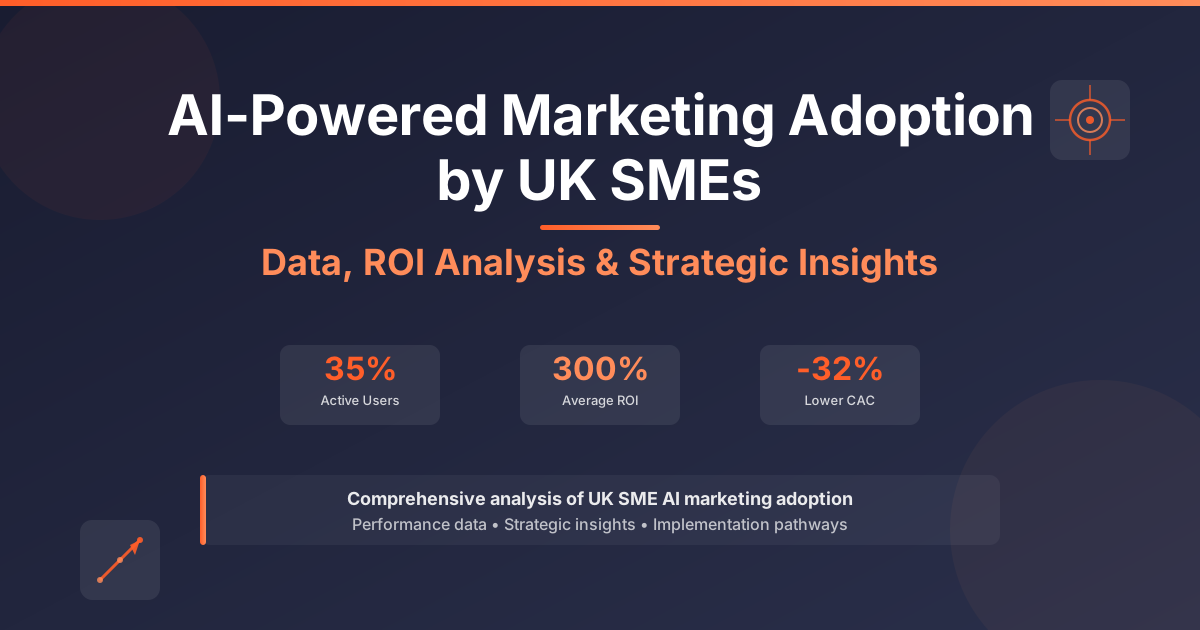
Recent research from the British Chambers of Commerce, surveying over 1,500 business leaders, reveals a striking acceleration in AI adoption. As of mid-2025, 35% of UK SMEs are actively using AI technology - a 40% increase from just 25% twelve months earlier. More tellingly, only 33% now report having no plans to use AI, down sharply from 43% in 2024.
This isn't merely statistical noise. It represents a fundamental reordering of competitive dynamics in the British business landscape.
What makes these figures particularly significant is the rate of change. Between 2022 and 2024, AI adoption among UK SMEs nearly doubled from 25% to 45%. The Office for National Statistics data shows that whilst only 9% of UK firms used AI in 2023, projections suggested this would reach 22% by end of 2024 - and we've already surpassed that threshold.
| Year | Active AI Users | Planning to Adopt | No Plans | Not Sure |
|---|---|---|---|---|
| 2022 | 25% | 22% | 48% | 5% |
| 2023 | 23% | 24% | 48% | 5% |
| 2024 | 25% | 24% | 43% | 8% |
| 2025 | 35% | 24% | 33% | 8% |
Table 1: UK SME AI Adoption Trajectory (2022-2025)
Sources: British Chambers of Commerce (2025), ProfileTree (2025)
The data reveals an inflection point. We're no longer in the "early adopter" phase - we've entered mainstream deployment, where businesses that fail to engage with AI are increasingly the outliers rather than the norm.
The Sectoral Divide: Who's Leading and Who's Lagging
Not all sectors are moving at the same pace, and this disparity reveals where competitive advantage is accruing.
B2B service firms - those in finance, law, marketing, and professional services - are leading the charge. Nearly half (46%) are actively using AI, compared to just 26% of B2C firms and 28% of manufacturers. The sectors trailing furthest behind include real estate (11%), transport and distribution (15%), hospitality and leisure (18%), and retail (19%).
| Sector | AI Adoption Rate | Sector Classification |
|---|---|---|
| IT & Telecoms | 56% | B2B Services |
| Media, Marketing & Advertising | 53% | B2B Services |
| Finance & Professional Services | 46% | B2B Services |
| General B2B Services | 46% | B2B Services |
| Manufacturing | 28% | Production |
| General B2C Firms | 26% | Consumer-Facing |
| Retail | 19% | Consumer-Facing |
| Hospitality & Leisure | 18% | Consumer-Facing |
| Transport & Distribution | 15% | Production/Logistics |
| Real Estate | 11% | Property |
Table 2: AI Adoption by Sector (UK SMEs, 2025)
Sources: British Chambers of Commerce (2025), YouGov Business Survey (2025)
This sectoral divergence matters because it shows where knowledge work and customer-facing activities are being transformed first. The firms closest to digital workflows - those already operating in information-dense environments - are adopting fastest. This creates a compounding advantage: early adopters develop AI literacy, refine processes, and accumulate competitive gains whilst late adopters are still evaluating options.
How UK SMEs Are Deploying AI in Marketing
Among SMEs using or planning to use AI, the applications are concentrated in five core areas:
| Application Area | Adoption Rate | Primary Benefit |
|---|---|---|
| Task Automation | 54% | Time savings, efficiency |
| Marketing & Advertising | 45% | Content creation, campaign optimisation |
| Product/Service Development | 37% | Market research, innovation |
| Customer Service | 31% | 24/7 support, chatbots |
| Operations & Logistics | 28% | Process optimisation |
Table 3: Primary AI Marketing Applications (UK SMEs, 2025)
Source: YouGov Business Survey (2025)
The prominence of marketing and advertising - second only to general task automation - underscores how critical AI has become to customer acquisition and retention. But within marketing specifically, adoption patterns reveal where SMEs are seeing the clearest returns.
According to ProfileTree's 2025 analysis, AI marketing applications in UK SMEs include:
- Automated marketing copy and content generation: Using tools like ChatGPT, Jasper, and Copy.ai to produce blog articles, email campaigns, and social media content
- 24/7 AI chatbots: Handling up to 80% of routine customer inquiries
- Predictive analytics: Forecasting customer behaviour and optimising campaign targeting
- Lead scoring and CRM intelligence: Automatically identifying high-value prospects
- Ad campaign optimisation: AI-driven bidding and audience targeting in Google Ads and Meta platforms
- SEO content strategy: Using AI to conduct keyword research, competitor analysis, and content optimisation
What's notable is that SMEs aren't using AI for a single function - they're deploying it across multiple touchpoints in the customer journey.
The Implementation Gap: Adoption vs Optimisation
Here's where the data becomes uncomfortable for many businesses: whilst 35% of UK SMEs are using AI, only 11% report using technology to a "great extent" to automate or streamline operations. A further 42% use it "to some extent", whilst 29% use it minimally.
This reveals a critical distinction between adopting AI and optimising with it.
| Implementation Level | Percentage | Description |
|---|---|---|
| Great Extent | 11% | Comprehensive automation/streamlining |
| Some Extent | 42% | Selective implementation |
| Minimal Extent | 29% | Limited/experimental use |
| Not At All | 14% | No AI use for automation |
| Using AI (any level) | 35% | Total active users |
Table 4: Depth of AI Implementation in UK SMEs (2025)
Source: British Chambers of Commerce (2025)
The businesses in the 11% "great extent" category are the ones seeing transformational results. They're the ones automating lead nurturing sequences, running AI-optimised paid campaigns, and using predictive analytics to forecast customer lifetime value. The rest are still learning.
The Business Case: How AI Marketing Drives Leads and Sales
The adoption rates are one thing. The commercial impact is what matters for business owners evaluating whether to invest in AI-powered marketing.
Global research from 2024-2025 provides clear evidence of AI's impact on marketing performance. Whilst UK-specific SME data is still emerging, the patterns are consistent across markets:
| Metric | Performance Improvement | Source |
|---|---|---|
| Marketing ROI | +300% average | Cubeo AI (2025) |
| Conversion Rates | +25-35% (Q1) | Shape The Market UK (2025) |
| Lead Generation (B2B, chatbots) | +10-20% | Statista (2024) |
| Customer Acquisition Cost | -32% reduction | AllAboutAI (2025) |
| Revenue Increase | +41% average | AISofto (2025) |
| Campaign ROI | +2.8x average | Shape The Market UK (2025) |
| Click-Through Rates (AI ads) | +47% vs traditional | Zebracat AI (2025) |
| Time Savings | 40% reduction in routine tasks | Shape The Market UK (2025) |
| Content Productivity | +44% higher productivity | Loopex Digital (2025) |
Table 5: AI Marketing Performance Impact (SMEs & Mid-Market, 2024-2025)
Sources: Multiple industry studies 2024-2025
Let me break down what these figures mean in practical terms for a UK SME.
Lead Generation and Conversion
AI-powered marketing isn't just making existing processes more efficient - it's fundamentally changing conversion economics. When B2B marketers deploy AI chatbots for lead qualification, they're seeing 10-20% increases in lead generation. This isn't because the chatbot is "better" than a human - it's because it's available 24/7, responds instantly, and can handle multiple conversations simultaneously.
For a professional services firm in Essex generating 50 qualified leads per month through their website, a 15% improvement means an additional 7-8 leads monthly. At a 20% close rate and £5,000 average client value, that's an extra £7,000-8,000 in monthly revenue from a single optimisation.
AI-driven campaign optimisation is showing even more dramatic results. Companies using AI for customer targeting report 40% higher conversion rates compared to traditional methods. This compounds: not only are you reaching more qualified prospects, but a higher percentage of them convert.
Consider a Chelmsford-based eCommerce business spending £3,000 monthly on Google Ads with a 2% conversion rate. A 30% improvement in conversion rate (well within the documented range) takes them to 2.6% - a seemingly small shift that translates to 30% more customers from the same advertising spend. If their average order value is £150 and they were previously getting 60 orders monthly (£9,000 revenue), they're now getting 78 orders (£11,700 revenue) - an additional £2,700 monthly with zero increase in ad spend.
Customer Acquisition Cost Reduction
The 32% average reduction in customer acquisition cost deserves particular attention because it directly impacts profitability and scale.
Lower CAC means you can:
- Bid more aggressively on competitive keywords whilst maintaining margins
- Expand into new customer segments that were previously unprofitable
- Reinvest savings into additional growth channels
- Improve overall business unit economics
A Southend service business spending £10,000 monthly on customer acquisition and bringing in 20 new clients (£500 CAC) could reduce that to £340 per client through AI optimisation. That's either £3,200 saved monthly, or the ability to acquire 29 clients with the same budget - a 45% increase in new customer volume.
Content Production and SEO Performance
Content marketing is where AI's efficiency gains become most visible. Research shows that 75% of marketers are using AI to reduce time spent on manual tasks like keyword research and content optimisation. The time savings are substantial: a 1,500-word blog post that previously required 8-10 hours now takes under 2 hours from concept to publication.
For UK SMEs competing in local search, this efficiency unlocks a different competitive advantage. You can now afford to create the comprehensive, authority-building content that was previously the preserve of larger competitors with dedicated content teams.
Take an Essex roofer competing in "roof repairs Southend". Creating monthly blog content covering seasonal maintenance, material guides, and local building regulations might have been economically unviable at 40 hours monthly. At 8-10 hours monthly using AI assistance (with human editing and local expertise), it becomes feasible - and that content compounds, building topical authority that drives organic visibility.
The SEO performance data supports this: 65% of companies using AI-generated content report improved SEO performance. More specifically, 52% of SEO professionals noticed performance improvements from using AI for on-page optimisation.
Where AI Leaves Money on the Table: The Opportunity Cost of Delayed Adoption
The data reveals an uncomfortable truth for SMEs that haven't yet adopted AI marketing tools: they're not just missing out on efficiency gains - they're actively losing ground to competitors who are compounding advantages month after month.
Consider the current adoption landscape:
- 35% of UK SMEs actively using AI (and growing at 40% year-on-year)
- 24% planning to adopt within the next 12 months
- 33% with no current plans
That final third - representing hundreds of thousands of UK businesses - face several compounding disadvantages:
1. Visibility Gap in AI-Powered Search
Google AI Overviews now appear in approximately 13-18% of searches, and when they do, traditional top-ranking positions see click-through rates drop by 34.5%. Businesses not optimising for AI citation are becoming less visible precisely when prospects are researching solutions.
For a Colchester accountancy firm appearing in position 1 for "accountants Colchester", historical CTR might be 7.3%. When AI Overviews appear, this drops to 2.6% - a 64% reduction in clicks for the same ranking position. Meanwhile, firms being cited within the AI Overview capture attention earlier in the decision journey, even if users don't click immediately.
2. Content Production Disadvantage
Competitors using AI are producing 3-5 times more content at comparable quality levels. In competitive local markets, this creates a dramatic topical authority gap. An Essex solicitor creating 1-2 blog posts monthly competes against an AI-enabled competitor producing 6-8 monthly - each optimised for different aspects of search intent, each building cumulative SEO value.
Over 12 months, that's 18-24 pieces of content versus 72-96. The compounding SEO benefit isn't linear - it's exponential as internal linking, topical depth, and domain authority accumulate.
3. Campaign Efficiency Disadvantage
Every month a business runs paid campaigns without AI optimisation is a month of higher customer acquisition cost versus competitors. If your CAC is £500 and AI-enabled competitors have reduced theirs to £340, they can bid 47% more on the same keywords whilst maintaining margins, expand into additional channels with profitable unit economics, and acquire customers from segments you've deemed unprofitable.
This isn't sustainable over multi-year timeframes. Eventually, the competitor with superior unit economics controls the market.
4. Time and Resource Misallocation
Marketing managers spending 8-10 hours writing a single blog post, manually researching keywords, creating email sequences from scratch, and updating meta descriptions by hand are allocating expensive human time to tasks AI can complete in minutes.
| Marketing Activity | Manual Time | AI-Assisted Time | Time Saved | Value @ £75/hr |
|---|---|---|---|---|
| 24 blog articles | 240 hours | 60 hours | 180 hours | £13,500 |
| Email campaigns (monthly) | 96 hours | 24 hours | 72 hours | £5,400 |
| Social media content | 156 hours | 48 hours | 108 hours | £8,100 |
| Keyword research | 48 hours | 12 hours | 36 hours | £2,700 |
| Ad campaign optimisation | 104 hours | 24 hours | 80 hours | £6,000 |
| Total Annual | 644 hours | 168 hours | 476 hours | £35,700 |
Table 7: Estimated Opportunity Cost of Non-Adoption (UK SME, Annual)
This represents pure opportunity cost - time that could be redirected to strategy, client relationships, or business development. It doesn't account for the performance improvements (higher conversion rates, better lead quality, reduced CAC) that AI optimisation delivers.
The Path Forward: Implementing AI-Powered Marketing in UK SMEs
Based on successful adoption patterns among the 35% of UK SMEs already using AI, several clear implementation principles emerge:
Start with a Single, High-Impact Use Case
The British Chambers of Commerce data shows that successful adopters don't attempt wholesale transformation immediately. They identify one bottleneck - lead generation, content production, customer qualification - and solve it thoroughly before expanding.
For most UK SMEs, the highest-impact starting points are:
- AI-assisted content creation for SEO and thought leadership
- Chatbot implementation for lead qualification and customer service
- Paid campaign optimisation using Google Performance Max or Meta Advantage+
Each of these can be implemented with modest investment (£500-1,000 setup, £200-500 monthly operational cost) and delivers measurable results within 60-90 days.
Maintain Human Oversight and Strategic Direction
The 93% of marketers who review AI-generated content before publishing understand a critical principle: AI handles execution, humans handle strategy and quality control.
For UK SMEs, this means using AI to draft content, with human editors ensuring accuracy, brand voice, and local relevance; deploying AI chatbots with clear escalation paths to human agents for complex queries; and running AI-optimised campaigns with strategic human oversight of messaging, positioning, and targeting.
Prioritise UK-Compliant, GDPR-Ready Solutions
UK SMEs must ensure AI tools comply with GDPR and the recently passed Data Use and Access Act (June 2025). This means verifying where data is processed and stored (UK/EU data centres preferred), understanding how AI tools handle customer data, implementing appropriate consent mechanisms for AI-driven personalisation, and choosing vendors with transparent data policies and UK market compliance.
This isn't merely regulatory box-ticking - it's competitive advantage. Consumers are increasingly aware of AI use in marketing, and transparent, compliant implementation builds trust.
Measure, Learn, Iterate
The 11% of SMEs using AI to "a great extent" didn't achieve optimisation overnight. They implemented, measured results, identified gaps, and refined processes systematically.
For an Essex SME implementing AI-powered marketing, this means establishing clear metrics: website traffic and organic rankings, lead volume and quality, conversion rates by channel, customer acquisition cost, content production velocity, and time saved on routine tasks.
Track these monthly, identify what's working, double down on successes, and adjust failures. AI tools provide more data than ever - use it to drive continuous improvement.
Why Now? The Narrowing Window for Early-Adopter Advantage
The window for competitive advantage through AI adoption is narrowing but hasn't closed. We're in what Geoffrey Moore termed "crossing the chasm" - the point where early majority adoption accelerates and late adopters face permanent disadvantage.
The data supports urgency:
- AI adoption growing 40% year-on-year among UK SMEs
- B2B service sectors already at 46% adoption
- Marketing and sales seeing the strongest AI revenue impact across industries
- Content production capabilities creating compounding SEO advantages
Businesses implementing AI marketing strategies in 2025 are still early enough to establish market position advantages that become difficult for competitors to overcome. By 2026-2027, when adoption likely exceeds 60-70%, AI optimisation will be table stakes rather than competitive advantage.
Final Thoughts: AI as Competitive Necessity, Not Optional Experiment
The 2024-2025 data reveals a clear inflection point in UK SME marketing. AI has moved from experimental technology to operational necessity. The businesses thriving in 2025 - those seeing 300% ROI, 40% conversion rate improvements, and 32% CAC reductions - aren't necessarily the largest or best-funded. They're simply the ones that recognised the shift and acted whilst others deliberated.
For UK SMEs, particularly those in competitive Essex markets and beyond, AI-powered marketing offers a rare opportunity: the chance to compete with larger competitors on relatively equal footing. Enterprise-grade capabilities that required six-figure budgets three years ago are now accessible for hundreds of pounds monthly.
But accessibility creates its own competitive pressure. When everyone can access the same tools, advantage accrues to those who implement earliest, learn fastest, and optimise most thoroughly.
The data is unambiguous. The competitive dynamics are clear. The only remaining question is execution.
Frequently Asked Questions
What percentage of UK SMEs are currently using AI for marketing?
As of mid-2025, 35% of UK SMEs are actively using AI technology, representing a 40% increase from 25% just twelve months earlier. Within that group, 45% are specifically using AI for marketing and advertising activities, making it the second most common application after general task automation (54%). However, there's a significant implementation gap: only 11% of SMEs report using AI to a "great extent" for automation and streamlining, whilst 42% use it "to some extent". This suggests many businesses are still in the experimental or selective adoption phase rather than comprehensive integration. B2B service sectors lead adoption at 46%, whilst consumer-facing sectors like retail (19%) and hospitality (18%) are lagging significantly behind.
How much can AI marketing improve conversion rates for UK SMEs?
Research from 2024-2025 shows that AI-powered marketing delivers conversion rate improvements of 25-35% within the first quarter of implementation for UK SMEs and mid-market businesses. Companies using AI for customer targeting specifically report 40% higher conversion rates compared to traditional methods. For B2B businesses deploying AI chatbots for lead qualification, the improvement ranges from 10-20% in lead generation volume. These aren't marginal gains - they represent fundamental improvements in marketing economics. For context, a business with a 2% conversion rate seeing a 30% improvement moves to 2.6%, which translates to 30% more customers from the same advertising spend. The compounding effect becomes even more significant when AI optimisation is applied across multiple channels simultaneously - paid campaigns, email marketing, content strategy, and lead nurturing.
What's the typical ROI from implementing AI marketing tools?
Marketing teams implementing AI solutions see an average ROI of 300% according to recent industry analysis, with the most methodologically rigorous studies showing organisations report a 41% average increase in revenue and 32% reduction in customer acquisition costs. Campaign-specific ROI averages 2.8x improvement in marketing spend efficiency for UK businesses. These returns stem from two primary sources: revenue growth through better targeting and conversion, and operational savings through automation and efficiency. The financial impact varies by sector, with retail and financial services experiencing the fastest payback periods - typically under nine months for 60% of deployments. For UK SMEs, typical AI marketing tool investments range from £250-500/month for entry-level suites to £500-1,200/month for comprehensive platforms. At the mid-range investment of £800/month, the time savings alone (40% reduction in routine tasks) often exceed the tool cost before accounting for performance improvements.
Which sectors are leading in AI marketing adoption in the UK?
B2B service firms are leading AI adoption, with IT and telecoms at 56%, media/marketing/advertising at 53%, and finance and professional services at 46%. This compares to just 26% for general B2C firms and 28% for manufacturers. The sectors trailing furthest behind include real estate (11%), transport and distribution (15%), hospitality and leisure (18%), and retail (19%). This sectoral divergence is significant because it shows where knowledge work and customer-facing activities are being transformed first. Firms closest to digital workflows - those already operating in information-dense environments - are adopting fastest, creating a compounding advantage. They're developing AI literacy, refining processes, and accumulating competitive gains whilst late adopters in consumer-facing and production sectors are still evaluating options. This gap is widening rather than narrowing, with adoption rates in leading sectors growing at 40% year-on-year.
How much time can AI save on content marketing activities?
Research shows that 75% of marketers use AI to reduce time spent on manual tasks like keyword research and content optimisation, with measurable productivity gains of 44% reported. Specifically, a 1,500-word blog post that previously required 8-10 hours now takes under 2 hours from concept to publication using AI assistance. For a typical UK SME marketing operation, annual time savings can be substantial: 24 blog articles save 180 hours (from 240 to 60), monthly email campaigns save 72 hours (from 96 to 24), social media content saves 108 hours (from 156 to 48), keyword research saves 36 hours (from 48 to 12), and ad campaign optimisation saves 80 hours (from 104 to 24). This totals 476 hours annually, valued at approximately £35,700 at £75/hour. Critically, 93% of marketers review AI-generated content before publishing, meaning these time savings come from AI handling drafting and research whilst humans focus on strategic refinement, quality control, and brand voice alignment.
What are the main barriers preventing UK SMEs from adopting AI marketing?
The top barriers to AI marketing adoption are lack of technical expertise (38%), data privacy concerns (40%), and cost of implementation (33%). Integration difficulties with existing systems affect 29% of businesses, whilst uncertainty about ROI impacts 25%. Interestingly, job displacement fears have nearly doubled from 35.6% in 2023 to 59.8% in 2025, with 81% of digital marketers fearing AI will replace content writers. However, this fear appears misplaced: marketing employment actually grew 6% in 2024 despite the AI surge, and 84% of marketing leaders believe AI will enhance rather than replace creative teams. The 70% burnout rate among marketing professionals not using AI tools suggests that resistance itself carries career risks. For UK SMEs specifically, the barrier isn't just cost - it's the knowledge gap about which tools to implement, how to integrate them with existing workflows, and how to ensure GDPR compliance under the recently passed Data Use and Access Act (June 2025).
How does AI impact customer acquisition cost for SMEs?
Organisations implementing AI in marketing functions report an average 32% reduction in customer acquisition cost compared to traditional approaches. This improvement stems from better targeting (reaching more qualified prospects), higher conversion rates (more prospects converting at each stage), and improved campaign efficiency (less waste in ad spend). Lower CAC creates multiple strategic advantages: you can bid more aggressively on competitive keywords whilst maintaining margins, expand into new customer segments that were previously unprofitable, reinvest savings into additional growth channels, and improve overall business unit economics. For practical context, a Southend service business spending £10,000 monthly on customer acquisition and bringing in 20 new clients (£500 CAC) could reduce that to £340 per client through AI optimisation. This represents either £3,200 saved monthly, or the ability to acquire 29 clients with the same budget - a 45% increase in new customer volume. The CAC reduction compounds over time as AI systems learn and optimise based on performance data.
Is AI-powered marketing suitable for small local businesses in Essex?
Absolutely - in fact, AI-powered marketing offers particular advantages for local Essex businesses competing in geographically-focused markets. The efficiency gains in content production allow local businesses to create comprehensive, authority-building content that was previously only economically viable for larger competitors with dedicated teams. For example, an Essex roofer competing in "roof repairs Southend" can now affordably create monthly blog content covering seasonal maintenance, material guides, and local building regulations. What might have been unviable at 40 hours monthly becomes feasible at 8-10 hours using AI assistance (with human editing for local expertise). This content compounds, building topical authority that drives organic visibility. AI also levels the playing field in paid advertising - Performance Max and Meta Advantage+ campaigns use the same AI optimisation whether you're spending £500 or £50,000 monthly. Local businesses benefit from local SEO integration, where AI-generated content optimised for "near me" searches and local intent can outperform generic national competitors.
Transform Your Marketing with AI-Powered SEO and Performance Marketing
The research is clear - UK SMEs deploying AI across their marketing operations are seeing measurable improvements in lead generation, conversion rates, and overall ROI. But understanding the data and implementing effective AI marketing strategies are very different challenges.
I help businesses across Essex and the UK implement AI-powered SEO and performance marketing systems that generate qualified leads and drive measurable growth. With over 14 years of experience in SEO and digital marketing, I combine proven methodologies with cutting-edge AI capabilities to deliver results that matter.
Whether you're looking to optimise for Google AI Overviews, implement AI-assisted content strategies, or deploy AI-powered paid campaigns, I can help you navigate the technical complexity and focus on what drives revenue.
The window for early-adopter advantage is narrowing, but it hasn't closed. If you're ready to explore how AI-powered marketing can transform your business growth, let's have a conversation about your specific challenges and opportunities.
Get in Touch- About the Author
- Latest Posts

George Papatheodorou is a UK-based SEO consultant with a background in Electrical Engineering & Computer Science and an MBA in Telecoms. Since 2012, he has specialised in Search Engine Optimisation (SEO), Google and Bing Ads, and Conversion Rate Optimisation (CRO), empowering businesses to elevate their online presence, attract targeted audiences, and secure top search engine rankings.